
Grandparenting While Caring for Aging Parents
How do you balance caring for aging parents, supporting adult children with new babies, staying connected to the ones without children, building a relationship with your grandchild, and still having some life of your own? It's a real question from a real reader—and it deserves a better answer than "ask for help."
I got an email one day with a question from Jenny. She wanted, she said, "some wise words on balancing meeting the care needs of aging parents, supporting adult children with young children, having time and relationships with adult children that don't have children and establishing relationships with grandchildren, whilst having some life for myself and my husband."
She shared details that sound familiar to anyone in a similar situation. Her father is in care. Her mother is living with Jenny and her husband while they wait for a placement—which is not easy to come by. There's a new, unsettled grandchild. Her son is getting married. Her husband is on the verge of retirement, but seeing the demands on Jenny’s time, he isn't sure he wants to go through with it.
Jenny retired from a highly demanding professional career and says some days that job looked easier. Her retirement, she wrote, does not look the way she envisioned.
When becoming a grandparent arrives at a complicated time in life
Most new grandparents picture their first grandchild arriving into a life that has space for them, but that's rarely how it works. Life doesn't pause to accommodate a new baby, and it certainly doesn't pause to accommodate the grandparent who wants to show up fully.
If you're grandparenting while also caring for aging parents, you're already carrying two major responsibilities that each deserve real time and energy. Add in an adult child going through a job loss, a partner who is newly retired and still finding his footing, a son whose wedding is consuming everyone's calendar—and the math simply doesn't work. There isn't enough of you to go everywhere at once.
At the core, this is a logistics problem, and it needs a logistical approach.
What does it mean when grandparents are pulled in every direction?
The version of this that gets the most attention is grandparent babysitting burnout—the exhaustion that builds when grandparents take on too much regular childcare. That's worth taking seriously; you can read more about it in our post on how to avoid grandparent babysitting burnout and in Depleted Grandmother Syndrome. But what Jenny is experiencing is different.
It's not too much of one thing. It's too many legitimate things, all at once, all involving people she loves. The question isn't how to set limits on childcare. It's how to make a reasonable decision about where to be when you can only be in one place.
How do grandparents decide where to show up first?
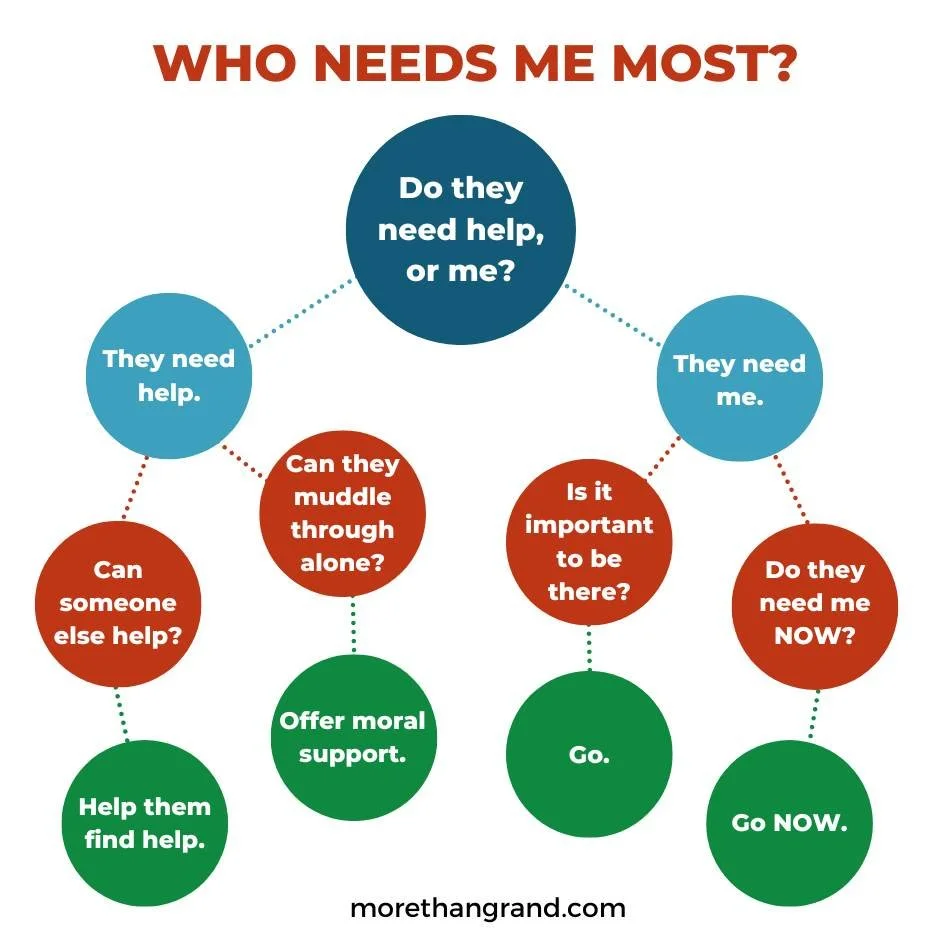
There's no formula that works for every family, but there are questions worth asking every time you feel the pull:
Who needs me, and how urgent is it really? A postpartum mother with a no other support is in a different situation from one who has her own mom nearby. An aging parent whose health is declining is different from one who is stable and well-supported. Urgency matters, and it's worth assessing honestly rather than responding to whoever called most recently.
What happens if I don't go? Sometimes the honest answer is "they'll have a hard few days and figure it out." Sometimes it's genuinely worrying. Not every difficult situation requires your physical presence to resolve.
Is there someone else who can help? You are not the only resource available to the people who love you, even when it feels that way. Who else could step in—another family member, a hired helper, a friend? If the answer is truly no one, that changes your decision. If the answer is "no one they want to ask," that's worth a longer conversation.
Will my going actually help, or am I helping myself feel less anxious? Sometimes we show up because it reduces our own worry, not because our presence is what's most needed. A phone call, a grocery delivery, or a hired postpartum doula might serve the person better than your being there.
What will I regret? Some moments in a family's life are retrievable. Others aren't. Factor that into your decision—not as guilt, but as information.
What can grandparents reasonably let go of?
Intentional grandparenting doesn't mean being available at every moment. It means being thoughtful about where your energy goes and protecting the relationships that matter most—including your relationship with yourself.
Some situations genuinely need you. Others need someone, and that person doesn't have to be you every time. Learning to tell the difference is one of the more useful skills of this stage of life, and it gets easier with practice.
Your own health belongs on the list, too, and not at the bottom of it. Grandparents who run themselves down trying to be everywhere can't show up well anywhere. If you're looking for practical ways to stay physically capable of keeping up, our fitness tips for grandparents are a good starting point.
How do you talk honestly with your family about your limits?
This is the piece most people skip, because it feels uncomfortable. But communicating your reasoning—to everyone who needs you, not just the one you're choosing—matters more than most grandparents realize.
When you tell your daughter you can't come this week because you're needed with your mother, and you explain why, you're doing something important. You're showing her that you take everyone's needs seriously, including hers, and that you make decisions thoughtfully rather than just reacting to whoever pressed hardest.
These conversations don't have to be long or elaborate. They do have to be honest. Our guide to difficult conversations for parents and grandparents can help you find the words when they don't come easily.
What does good grandparenting look like when you're stretched thin?
It looks like showing up when you can—fully, and without resentment. It looks like staying connected even when you can't be there physically: a call, a letter, a package that says you were thinking of them. And it looks like being honest about what you have to give, rather than promising more than you can deliver and then struggling to follow through.
There's no version of this stage of life where everyone's needs get fully met all the time. But grandparents who ask better questions—about urgency, about who else can help, about what they'll regret—make better decisions than those who simply respond to whoever pressed hardest. And the ones who explain their reasoning to their family are showing them what it looks like to take care of one another with respect and love.
You May Also Like
Depleted Grandmother Syndrome: Warning signs, causes & solutions
Long-Distance Grandparenting: Ideas to Help New Parents from a Distance